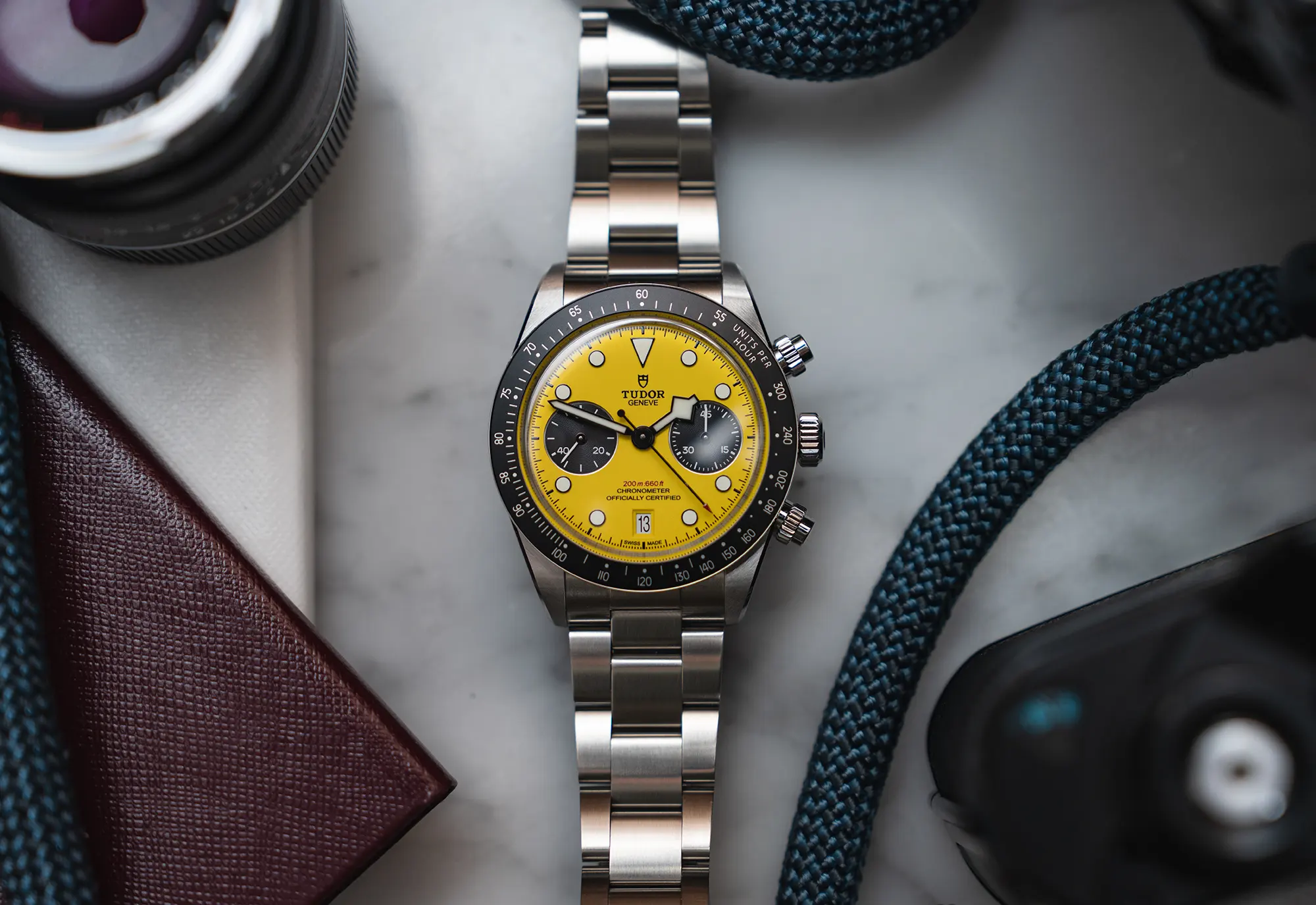
Tudor is nothing if not unpredictable. But there is a method to their madness, and while some of the details might feel random (Born to Dare and all that), the broad strokes reveal a cohesive evolution. As a result, it’s often best to tune out the noise when trying to discern the long term direction of the brand. The unintended result of this can be watches that we want to see, executed in ways that undermine the core changes. Think of the Black Bay 58 GMT, a watch many of us had been dreaming of, eventually delivered in a single throwback style colorway, which quickly became the talking point. With the Black Bay Chrono 39, we once again find a watch in near ideal packaging, with a single potentially polarizing detail, in this case, a bright yellow dial. But this one feels a little different, and may foreshadow bigger changes.

To be clear, I think it’s a good thing when brands make creative decisions for their own reasons rather than acting on what they think will be most commercially viable. Making polarizing watches ultimately creates a more interesting landscape of options for buyers and enthusiasts to enjoy. As such, I generally applaud a brand the size of Tudor making unexpected creative choices. The Black Bay Chrono 39 certainly isn’t unconventional by any stretch, and in fact, showcases a number of well thought out, highly intentional details. But the yellow dial will be a bridge too far for many enthusiasts to get on board. Especially enthusiasts that have fallen in love with the no-nonsense tool watches we’ve become accustomed to from Tudor.
Looking deeper, Tudor has done a tremendous job in creating a Black Bay Chrono in a trimmer size, and that goes well beyond simply making it smaller. They’ve found a way to do more with what they have, meaning they didn’t have to reinvent the wheel to get this right, they just needed to show some intent with the design, and that’s exactly what they’ve done. And of course, this is not the first yellow chronograph from the brand.
History
As with many of the decisions we see Tudor make, there is a precedent for the yellow dial in a chronograph. It should come as no surprise that that precedent was set in the ‘90s. Shortly after winning his first Masters at the age of 21 in 1997 (in dramatic style), Tiger Woods was signed as an ambassador by Tudor watches. Ironically, this came about a year after pulling out of the US market due to poor sales. The watches to come out of this partnership were some of the most expressive chronographs to ever be made by Tudor, and included green, red, and yellow dial options within the Oysterdate Chronograph, which would become the Prince Date Chronograph collection (this was post big block era).

This generation continued to use the Valjoux 7750, but shifted to a softer case design and offered both steel and aluminum insert bezel options, as well as a 12 hour variation (an interesting detail to keep in mind). Like a lot of watches from this era, there were some risks being taken in these designs, and not all of them would age with grace. On the other hand, the non-Tiger variations of these chronographs have aged quite nicely, featuring classic silver and black, and panda style configurations.
This was also an era of Tudor attempting to put some distance between themselves and Rolex, removing all traces of the parent brand from the crown and caseback. Landing on a strong identity that resonated with a broad customer base proved a challenge, and by the mid ‘00s Tudor went back to the drawing board in many ways which, in hindsight, was likely a good call as they came out of this stretch ready to roll in the US with a new collection called the Black Bay.

A year prior to the release of the Black Bay, Tudor introduced a new chronograph collection called the Fastrider in partnership with Ducati, and while it was somewhat short lived, it did have overlap with the boom years brought on by the Black Bay. I remember there being a Ducati motorcycle in the booth on my way in to see the Black Bay for the very first time at Baselworld that year. The Fastrider collection would also see a yellow dial variation released, complete with black accents and an integrated end-link attached to a synthetic strap.
Okay, so yellow dials don’t represent any real tentpole moments of Tudor history, but they do make an appearance on multiple occasions, albeit in times when the brand was on shaky ground. Today, Tudor is a pretty good place, and is making a conscious choice to take a swing at the yellow dial once again, and they’re doing in what might be the best chronograph case they’ve ever made, housing their own movement.
Black Bay Chrono 39

The Black Bay Chrono 39 is an entirely new expression of the Black Bay Chrono, sporting a trim 39mm case that measures a whisker over 13mm in thickness (with a domed sapphire), and a 47mm lug to lug length. It’s one of those chronographs that boasts a near perfect stat line on paper, and while that doesn’t always guarantee a great on-wrist experience, in this case, it does. More on that later.
The bright yellow dial is joined by a pair of black sub-dials totalizing the minutes (at three o’clock), and showing the running seconds (at nine o’clock). This situation is framed by a black aluminum insert, completing a yellow and black look that has earned it the unsurprising nickname of ‘bumblebee’. At a glance, the general design closely follows the template set by the existing 41mm Black Bay Chrono, with circular hour markers, a date at six o’clock, and those familiar snowflake style hands. A closer look reveals some important changes, however.

The first difference you’ll notice is just how close under the crystal the dial resides. Remember, this is using the same movement you’ll find in the 41mm Black Bay Chrono, which measures 14.4mm in thickness, so to save as much space as possible, the dial has been moved up as far as possible. I personally like the effect that this has on viewing the watch, as it allows less room for distortion at the edges, and provides a sort of HD view of the dial. It’s the same story with the dial of the FXD, which is an all-time great in my book.
Next are the hands, which have been ever so slightly re-worked to provide better visibility to the sub-dials even with the hands overhead. This is a small difference, but it’s one you’ll notice in practice. The large snowflake shape at the end of the hour hand was a particular culprit in blocking any data you may be looking for in a sub-dial, but that’s been reduced here in scale, so it’s not quite as egregious.

Moving to the bezel insert, we find a matte black piece of aluminum with a redesigned tachymeter scale. The scale and its markings have been given a thoughtful re-work to provide a sense of visual priority, with different sized dots, and hashes that expand and grow depending on the speed. It’s a small thing, but it makes a big difference in the overall feeling of the watch, and sets it that much further apart from the 41mm Black Bay Chrono.
Case & Movement

The big change here comes from the new case, which is not simply a scaled down version of the 41mm unit. This is a very good thing, and helps the watch find its own footing as well as creates a better foundation for additional colorways down the line (fingers crossed). This includes a re-profiled chamfer that reads much more old-school, with a shallow but wide polish defining the edge of the lug that widens toward the tip.
Additionally, the caseback has been buttoned up to save some space, but I’d have had less of an issue with a deeper caseback piece. It’s really just that Tudor watches tend to carry their entire thickness in the case wall. This watch has a manageable case wall, which does wonders on the wrist, so if the caseback was a little more pronounced I don’t think it would affect wearability all that much.

As mentioned, Tudor is using the same automatic caliber MT5813 that you’ll find in the 41mm Black Bay Chrono and 43mm Pelagos FXD Chrono (which measures 13.3mm in thickness, btw). The movement has been regulated to chronometer spec, but stops short of their METAS certification. It’s sealed well enough to provide a 200 meter depth rating, and has a 70 hour reserve. All good stuff, and about on par with what we should expect in a modern chronograph movement at this price point.
On the Wrist

There’s no beating around the bush here, the Black Bay Chrono 39 is exceptional on the wrist. Full stop. It’s easy to get along with in daily use, even when that use includes some light activities. It ranks right up there with the Black Bay 54 in terms of ease of wear, which is pretty high praise.
One thing I noticed with the sample I had was just how firm the winding action felt. Take that with a grain of salt as it was a sample provided by the brand. Additionally, the pushers are screw-down, so actually using the chronograph requires an extra step or two. I find that I don’t use the chronograph all that much in day to day use, and I find the tradeoff for the better aesthetic (in my opinion) worth it.

The bracelet does use the T-Fit clasp, so adjustments can be made on the fly. Mercifully, Tudor has refrained from using the riveted bracelet, so the whole thing feels a bit more mature and modern. I would guess that, should we get a throwback variation in this case it will likely have the riveted bracelet. I also think a five-link bracelet would work quite well in this case, and that’s an option I fully expect to see down the line, given their trend in bringing it to existing references.
Looking Ahead / Conclusions

I’ve found myself singing a similar tune when it comes to Tudor releases in recent years, which goes along the lines of ‘don’t get bogged down in the wrong details, the bigger picture is more important’. Just like touring an open house, you don’t fixate on the drapes or the rug, you focus on the bones. However, we have yet to see the payoff for a lot of the watches I’ve said that about. We still only have a single Black Bay 58 GMT colorway. The monochrome variation hasn’t made its way into the time-only Black Bay 58. That Only Watch Big Block tribute remains a singular example. The compact GMT treatment still hasn’t come to the Pelagos collection, much less the Black Bay Pro (remember that watch?).
The point is, I find myself once again saying the same thing, and at this point, I worry that the payoff may not be around the corner. However, the Chrono 39 feels a little different, largely due to the small details that have been addressed here. It’s not simply a shrunk down Black Bay Chrono. It certainly feels like it’s setting the stage for additional variations within a collection. But, maybe that’s just me being optimistic. If the Chrono 39 remains yellow, and only yellow, then we will once again come that close to greatness without ever really grasping it. Not that there’s anything wrong with this yellow dial, but this case deserves to embrace Tudor’s full chronograph history in modern guise.